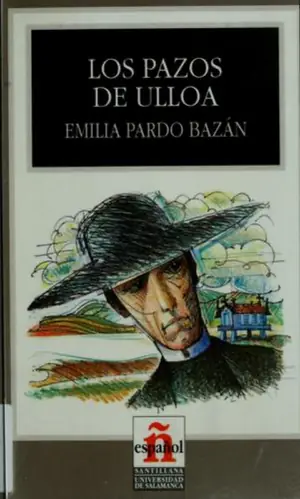
Spanish · Advanced
Read Los pazos de Ulloa in Spanishwith every sentence explained
English title: The House of Ulloa
Emilia Pardo Bazán · 1886
Free to start · iPhone, iPad & Mac
About the book
Los pazos de Ulloa by Emilia Pardo Bazán was first published in 1886. In Passage you read the full text in the original Spanish, marked advanced and filed under historical fiction and romance. It runs to about 83,400 words.
A crumbling manor. A lord gone wild. A young priest out of his depth.
Julián Álvarez is a gentle, timid young priest sent from the city to serve as chaplain to the Marquis of Ulloa, master of an old stone manor deep in the Galician countryside. He expects a noble household. He finds mud, dogs, hunting rifles and chaos.
The marquis, Don Pedro, is a rough, hot-blooded country lord. The real power belongs to his sly steward, Primitivo, whose beautiful daughter Sabel lives with Don Pedro as his mistress, while her little boy runs half-wild through the house. Horrified, Julián persuades his master to find a proper wife in the city, never imagining what that decision will set in motion.
Emilia Pardo Bazán's The House of Ulloa (1886) is the masterpiece of Spanish naturalism: a dark, atmospheric story of violence, faith and decay in rural Galicia. It was adapted as a popular TV series in 1985.
- Author
- Emilia Pardo Bazán
- First published
- 1886
- Language
- Spanish
- Level
- Advanced
- Genre
- Historical Fiction, Romance
- Length
- About 83,400 words
How it opens
Por más que el jinete trataba de sofrenarlo agarrándose con todas sus fuerzas a la única rienda de cordel y susurrando palabritas calmantes y mansas, el peludo rocín seguía empeñándose en bajar la cuesta a un trote cochinero que descuadernaba los intestinos, cuando no a trancos desigualísimos de loco galope.
Reading Los pazos de Ulloa in Passage
Passage sets the book as a quiet, paginated reader in Spanish. Read at your own pace, and when a sentence stops you, tap it. You get:
- a natural translation of that exact sentence,
- a short note on the grammar, in plain words,
- the key words, which you can save with the sentence they came from,
- all of it in English, Spanish, French, German, Italian, Turkish or Portuguese, whichever you read best.
It's marked advanced, with richer vocabulary and longer sentences. If it feels heavy, start with an intermediate Spanish book and come back to it. The words you save come back later in short review games, so the book keeps teaching after you close it.