English · Advanced
Read Wuthering Heights in Englishwith every sentence explained
Emily Brontë · 1847
Free to start · iPhone, iPad & Mac
About the book
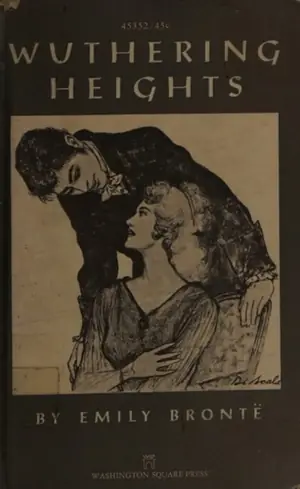
Wuthering Heights by Emily Brontë was first published in 1847. In Passage you read the full text in the original English, marked advanced and filed under historical fiction and romance. It runs to about 115,800 words.
A wild house on the moors. A love that will not die.
Snowed in at a bleak farmhouse on the Yorkshire moors, the new tenant Mr Lockwood meets its owner, the cold and savage Heathcliff — and that night, something taps at his window and begs to be let in.
Curious, Lockwood asks the housekeeper Nelly Dean to explain. Her story begins decades earlier, when old Mr Earnshaw brought home a ragged foundling boy from the streets of Liverpool. Heathcliff and Earnshaw's daughter Catherine grew up running wild across the heath together, bound by a passion as fierce and untamed as the land itself.
Emily Brontë's only novel was considered shocking in 1847. Today Wuthering Heights is celebrated as one of the most powerful, haunting love stories ever written.
- Author
- Emily Brontë
- First published
- 1847
- Language
- English
- Level
- Advanced
- Genre
- Historical Fiction, Romance
- Length
- About 115,800 words
How it opens
1801—I have just returned from a visit to my landlord—the solitary neighbour that I shall be troubled with. This is certainly a beautiful country! In all England, I do not believe that I could have fixed on a situation so completely removed from the stir of society. A perfect misanthropist’s Heaven—and Mr. Heathcliff and I are such a suitable pair to divide the desolation between us. A capital fellow!
Reading Wuthering Heights in Passage
Passage sets the book as a quiet, paginated reader in English. Read at your own pace, and when a sentence stops you, tap it. You get:
- a natural translation of that exact sentence,
- a short note on the grammar, in plain words,
- the key words, which you can save with the sentence they came from,
- all of it in English, Spanish, French, German, Italian, Turkish or Portuguese, whichever you read best.
It's marked advanced, with richer vocabulary and longer sentences. If it feels heavy, start with an intermediate English book and come back to it. The words you save come back later in short review games, so the book keeps teaching after you close it.